Thursday, November 2, 2017

Microphones

Microphones. Every studio needs them. They are used to capture sound by converting acoustical energy (which are sound waves) into electrical energy (which is the audio signal). We also need to know the microphones that we use and what are their characteristics. Here are the mics that we have in our recording studio and a little bit about them.


First of all, here are the types of polar patterns that mics have.


AKG C451B
This is a small diaphragm condenser microphone. It has a cardioid polar pattern. The microphone has a frequency bandwidth of 20-20000 Hz. However, the polar pattern starts rolling off at 200 Hz  and below and gets unstable after 5000 Hz. It has a bass cut filter option of 75 Hz and 150 Hz so we can get rid of the low frequencies that may be unwanted. It also features an attenuation pad option of -10 and -20dB in case the source signal is too loud. 


C451 frequency response


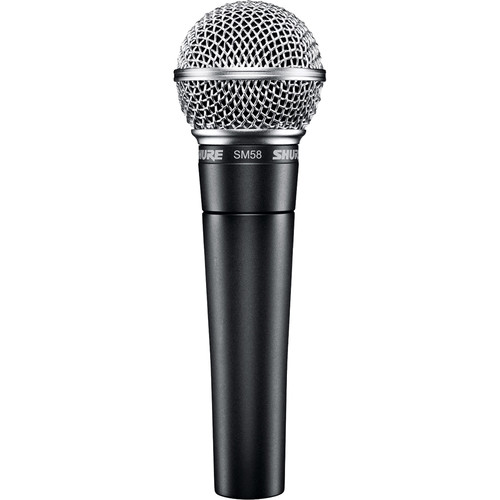
Shure SM58

Image result for shure sm58

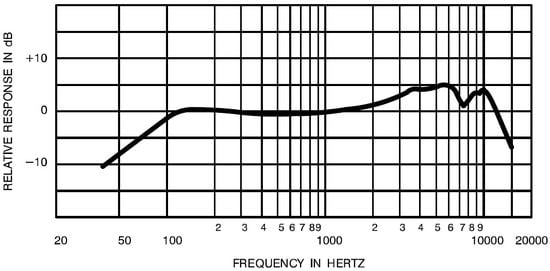
This is a dynamic microphone. It features a built in pop filter and is most famously used for vocals, Its frequency is range is from 50-15000 Hz and has a cardioid polar pattern.

Image result for shure sm58 frequency response
Shure SM58 frequency response


Shure SM57
Image result for shure sm57
This is another dynamic microphone by Shure. It has a cardioid polar pattern and a frequency bandwidth of 40-15000 Hz. It isn't known for vocals but rather on instruments because the sound it produces is quite favoured.
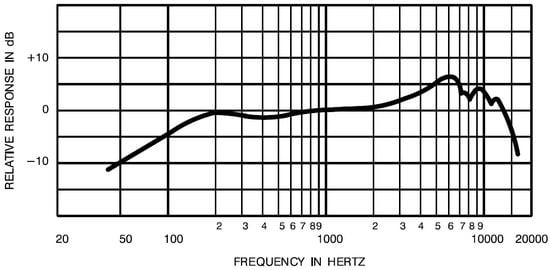
Image result for shure sm57 frequency response
SM57 frequency response


Sennheiser MD421
Image result for sennheiser md421
This dynamic microphone features a unique bass roll off switch. There are 5 positions with both extremes labeled 'M' and "S'. 'M'' being music with the least bass roll off while 'S' means speech which has the most bass roll off. There are  3 more options in between these two options to adjust a more specific level of bass roll off. This microphone has a frequency bandwidth of  30-17000 Hz and a cardioid polar pattern.
Sennheiser MD421 frequency response


Audio Technica  AT2050

This is a large diaphragm condenser microphone which has a frequency range of 20-20000 Hz. Unlike other microphones, this does not have a fixed polar pattern. It is interchangeable between omnidirectional, figure-8 and cardioid. It has a 10dB pad which can be used in case the signal input is too high.
Audio Technica AT2050 frequency response


Neumann TLM 103
Image result for neumann tlm 103
The Neumann TLM 103 is also a large diaphragm microphone and shares the same frequency range as the AT2050, 20-20000 Hz. It has a cardioid polar pattern. It is quite versatile and is used for vocals and instruments too.
Neumann TLM 103 frequency response


Basics of Sound

Sound
Sound is produced from the vibration of air particles that hit our eardrum. There are many ways that we can vibrate the air particles to produce sound. For instance, plucking a string, hitting a drum, shouting and basically almost everything we do involves vibrating air particles. Interesting thing to think about; sound is only created when these particles hit our eardrums, therefore, sound is only present when there is a listener to perceive it. 


The diagram above shows a sound wave. The wavelength is how long it takes for the wave to make one oscillation. The shorter the wavelength, the higher the pitch. The frequency is measured in hertz(Hz)The amplitude is how high the wave is. The higher the wave, the louder the sound. 


We can see the effects the sound wave has on the sound produced from the diagram above. 


The Harmonic Series

The overtone series (or the harmonic series) is the sequence of sound where each frequency is a multiple of the fundamental, the lowest frequency. Basically, the note that is played is the fundamental while the multiple of frequencies that are produced after that are the overtones. As we go up the series, the intervals start becoming smaller but they are also harder to hear.


Introduction

Just a little bit about myself. I, Aaron Victor, am currently studying Contemporary Music and Audio Technology in Sunway University. Just like most people, I love music and can't go a day without it but what always intrigued me was how music was produced. How great songs are written and composed. How people were able to record the instruments in great quality and let the people of the world enjoy it. 

I myself play the piano and guitar but I'm slowly learning a couple more instruments. I aspire to be producer in the future. I don't see myself as a performer but rather the guy in the control room making the magic happen. I'm writing this blog to record my experiments and my journey throughout this course as I learn more and more everyday.

Microphones

Microphones. Every studio needs them. They are used to capture sound by converting acoustical energy (which are sound waves) into electrical...